
Fixing how SIGNAL reads company information, prices and forms
Netsujo Inc. ·
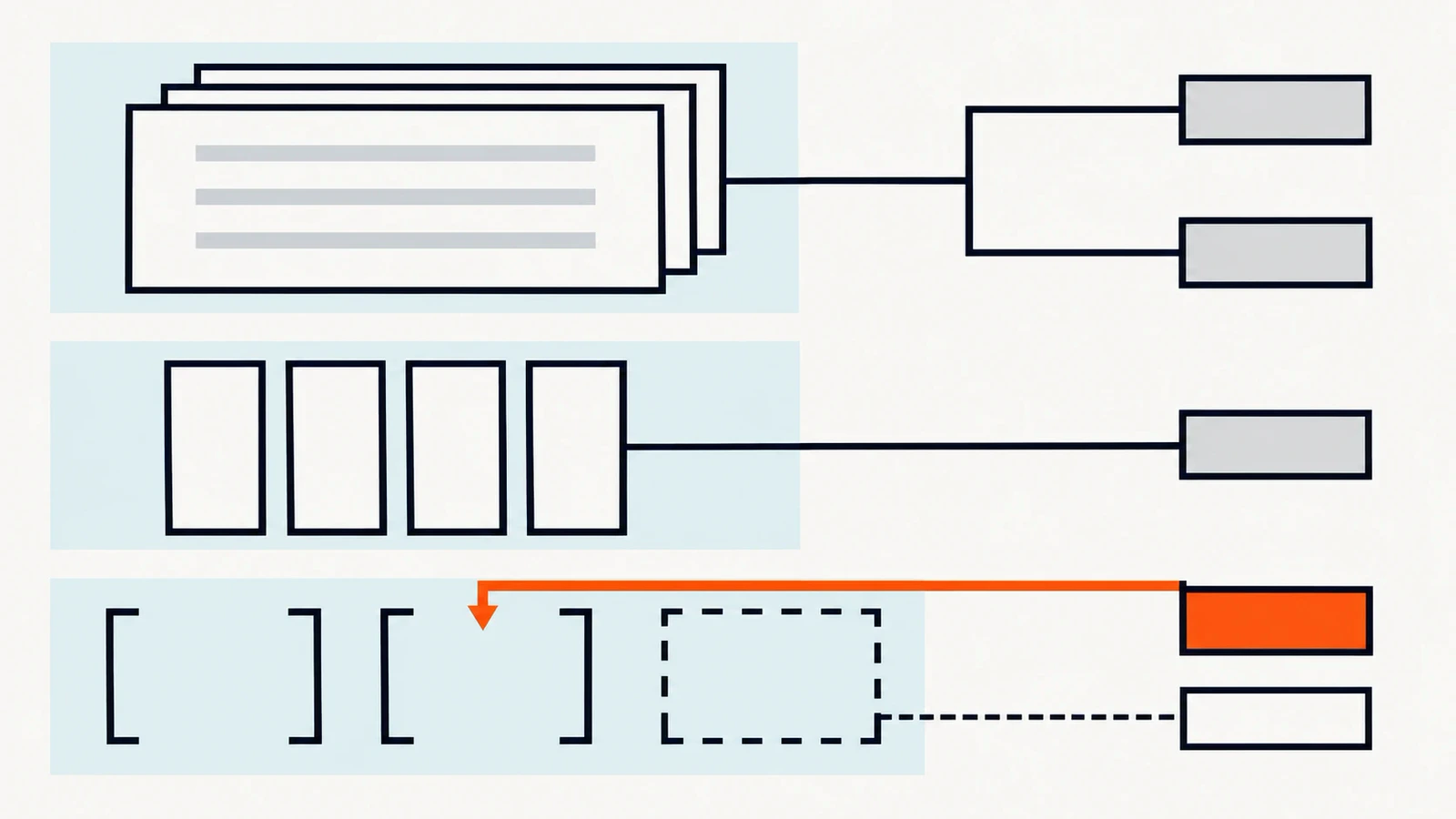
When a company page yields two names for the head of a business, the first question is which legal entity each name belongs to. A page listing several group companies can have a good reason to show different names. Assigning them to the wrong entity can send a website improvement proposal in the wrong direction.
In November 2026, Netsujo improved SIGNAL's extraction and candidate-evaluation logic for company information, prices and forms. This article describes misreadings reproduced during development and the handling checked after the changes. The work concerned rule-based processing, rather than training an LLM itself.
Establish the facts an improvement proposal depends on
Reading a website and proposing changes requires connecting each value to its subject: a legal entity for a company representative, a plan for a price, and a purpose and required status for an input field. Collecting values without those connections can turn consistent information into an apparent conflict or lead to comparisons between unrelated prices.
The following examples were checked using test fixtures and review probes. They do not represent a count of misdiagnoses on customer websites or the accuracy of all live functionality. If the table does not fit on your screen, you can scroll it horizontally.
| Information observed | Where the misreading occurs | What to check after the change | When the result cannot be determined |
|---|---|---|---|
| Company tables for several legal entities on one page | Different representatives or employee counts are treated as conflicting facts about one entity | Establish the entity scope first, then compare values that belong to the same entity | Retain the observations with entity scope unresolved |
| Prices for several plans, including “from” and whole-project pricing | A neighboring plan's price is attached to the wrong plan; a lower bound becomes a fixed price, or a project total becomes a monthly fee | Read the plan name and content boundaries together with the amount, tax treatment, unit and charging basis | Mark the price as requiring review, without inventing a fixed amount |
| Form select, checkbox, hidden and label elements | A choice field becomes a message field; a system field becomes customer input burden; a visible “required” label becomes an HTML required attribute | Separate the evidence for field classification from the actual attributes, and record the fields that can be established | Leave required status unconfirmed, and do not infer the primary form |
The common decision is to establish what each value belongs to and pass unresolved questions to the next check. We have not assessed effects through a fresh diagnosis of production websites. The pricing components, in particular, were not connected to customer-facing flows at the time of the change.
Determine the legal entity before comparing company facts
For company information, a synthetic fixture containing several company tables reproduced a problem: differences in representatives and employee counts were treated as conflicts within one entity. Treating the whole page as a description of a single company let values from other entities enter the comparison.
The change uses labels such as company name, trading name and legal name at the start of a company-information block to identify the subject. It normalizes legal-form variants, Japanese abbreviations such as “㈱” and “(株),” full-width and half-width characters, and spacing. Values are compared where they can be attributed to the same entity.
That change also has a failure boundary. Treating an English alias, former name or heading about a business partner as a new entity boundary too readily can hide real conflicts within one company. Independent review raised such counterexamples, and we revised the scope rules. After the changes, 18 review probes confirmed detection of conflicts within the same subject and an unresolved result for pages containing two legal entities.
When the subject cannot be determined, both observations are retained. The process does not select one as the authoritative company fact or promote it into a structured-data proposal as confirmed information. It records that the entity scope is unresolved.
Conservative handling still misses some cases, including parent-company headings without a company-name label and English company names containing spaces. Handling differences in the dates represented by individual observations also remains unimplemented. We have not rerun diagnoses on production websites to measure a reduction in false warnings.
Keep an amount and its conditions in one observation
For prices, we reproduced partial matches on plan names and contamination from amounts belonging to neighboring plans. The revised logic reads from the specified plan heading to the next different plan heading, then checks the amount, tax treatment and unit within that boundary. Where attribution remains unclear, the price requires review.
The components covered here were pure functions that generate public-offer candidates and a read-only reader. At the time of the November 5, 2026 change, they had no callers from the Portal, MCP or diagnosis flow and were not connected to customer-facing paths. The examples below are inputs used to check that candidate-processing logic.
“900,000円(税別)から” means “from JPY 900,000, tax excluded.” It is a lower bound, which carries different terms from a fixed JPY 900,000 price. Information describing a project total also remains a project total, without being converted into a monthly fee. A useful comparison needs the amount together with its tax treatment, unit and charging basis.
We added counterexamples for Japanese amount notation as well. During the changes, the logic had cases that read “1.5万円” as JPY 50,000 and “1万5千円” as JPY 5,000. We corrected both to JPY 15,000. These were results reproduced in probes and tests, not records of incorrect customer billing.
The Japanese character “約” needed similar care. Although it can mark an approximate amount, its appearance within “契約” (contract) or “予約” (reservation) is not evidence that a price is approximate. The logic needed to consider how the character was being used in relation to the amount.
For notations absent from the public-page text examined, the effects of the correction were confirmed only within the test inputs. Those results do not establish accuracy across every page or unfamiliar notation, or show that production outputs to customers were repaired.
Separate a field's purpose from evidence that it is required
In form extraction, we corrected cases that treated a selectable inquiry category as a free-text field, or a newsletter checkbox as an email-address input. Address components such as a prefecture field remain classified as address information. Establishing a field's purpose provides a sounder basis for considering input burden.
Element names also needed care. A field with type="tel" and name="fax" should not automatically become a telephone-number field. The letters in hotel_name should not make it a telephone field, nor should the “name” in product_name make it a person's name. The classification checks evidence in order: autocomplete, input-element attributes, then the associated label.
For required status, we distinguished the string required inside an attribute value from an actual HTML required attribute. We also separated data-type="email" from type="email". A visible “必須” (required) label or asterisk is retained as a visible marker and kept separate from the count of required fields established through HTML attributes.
Classification evidence and required-status evidence are recorded separately in kindSource and requiredSource. Label text and entered values are not stored. The absence of required or aria-required leaves the business requirement unconfirmed; it is not used to infer that the field is optional. The process also avoids guessing which form is primary when there are several candidates.
Fields marked hidden, disabled, aria-hidden, or hidden through inline styling are excluded from the estimate of customer input burden, as are system fields such as CSRF, CAPTCHA responses and honeypots. However, static HTML alone does not resolve fields hidden through CSS on a parent element. Form submission was not tested either, so these extraction results do not justify removing fields or claiming an increase in inquiries.
Preserve failing inputs and check the behavior after a repair
We retained inputs that reproduced misreadings in the original logic. Running the same inputs after a change provides a common basis for comparing the original problem with the revised handling.
Of the 12 added form tests, 10 failed on the pre-change implementation; the other two protected existing behavior against regressions. This separated the newly repaired cases from behavior that needed to remain intact.
For company information, independent review supplied examples where a change intended to keep separate entities apart could conceal a real conflict within one entity. For prices, inputs that varied plan attribution or amount units exposed other errors. Keeping both examples that represent the intended behavior and counterexamples at its boundaries was central to this work.
What still needs checking before production use
A fixture producing the expected classification, a reader processing public-page text, and a valid result generated in production each answer a different question. The central evidence in this article concerns extraction and candidate-evaluation logic checked against controlled inputs and counterexamples.
Open questions remain: differences in the dates represented by company information, the pricing components' lack of connection to customer flows at the time, and the forms' appearance after JavaScript execution and their submission behavior. The next stage needs a fixed target URL and retrieval time, with the original page, extracted result and proposed change examined together.
An unresolved status gives the next person a specific question to investigate. They can establish the entity boundary, confirm a pricing unit, or inspect the actual screen for a required condition. Passing on the missing evidence makes a pending decision actionable.
A checklist for receiving a website diagnosis
When you receive a diagnosis of your own site, choose one finding and collect the following details. The checklist connects the observation to the decision about what to change before implementation is commissioned.
| Item to check | Question for the person providing the finding |
|---|---|
| Subject | Which legal entity, plan or input field does this value concern? |
| Evidence | Which URL, content boundary or attribute supplied the information? |
| Time | When was the information retrieved, and do the items being compared refer to compatible dates? |
| Uncertainty | What remains unresolved? Were any gaps filled by inference? |
| Change decision | Who will review the information, and what evidence will they use to decide on a change? |
Netsujo SIGNAL is a continuous improvement service for developing a website into a sales foundation, where customers can discover, understand and compare an offering before moving toward a purchase or engagement. If a finding about company information, pricing or an inquiry path is difficult to judge, start with the target URL and the unresolved question. We help organize those details into a specification that an internal team or existing website partner can use to decide on a change.