
AI Agents for Small Teams: What to Automate and What Judgment to Keep Human
Tomohiro Iida · Published October 3, 2026 · Updated October 3, 2026
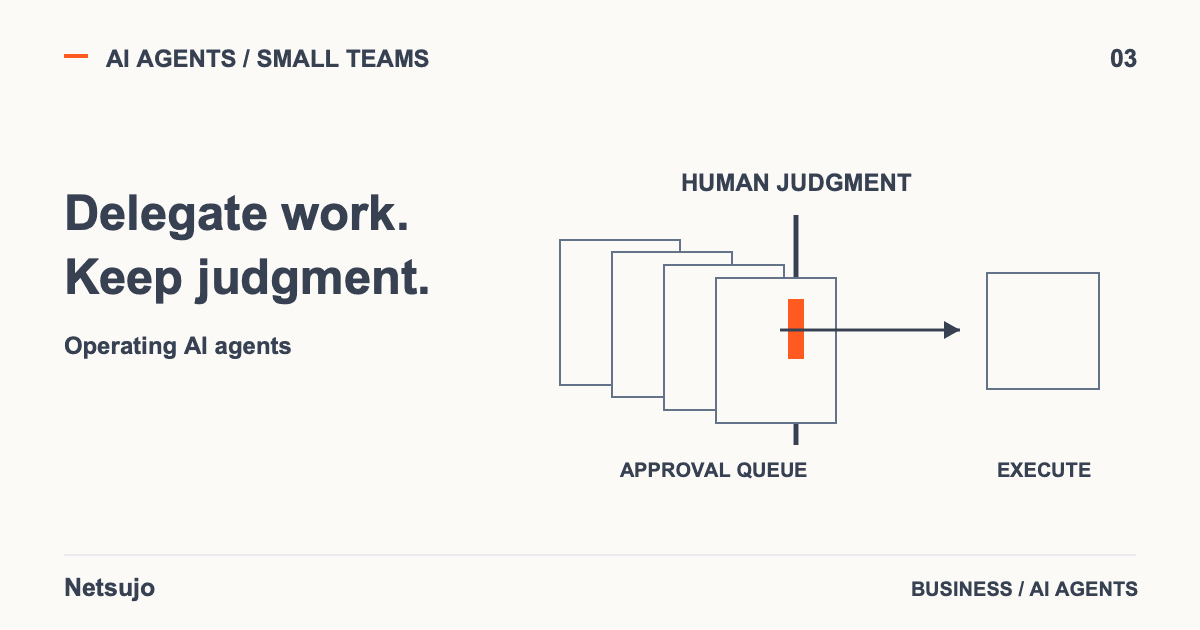
When a small company adds more AI agents, the first scarce resource may not be headcount. It may be the attention required to review, approve, and redirect everything the AI produces.
Key takeaways
- In a small team, review and approval capacity can become the bottleneck before AI generation capacity does.
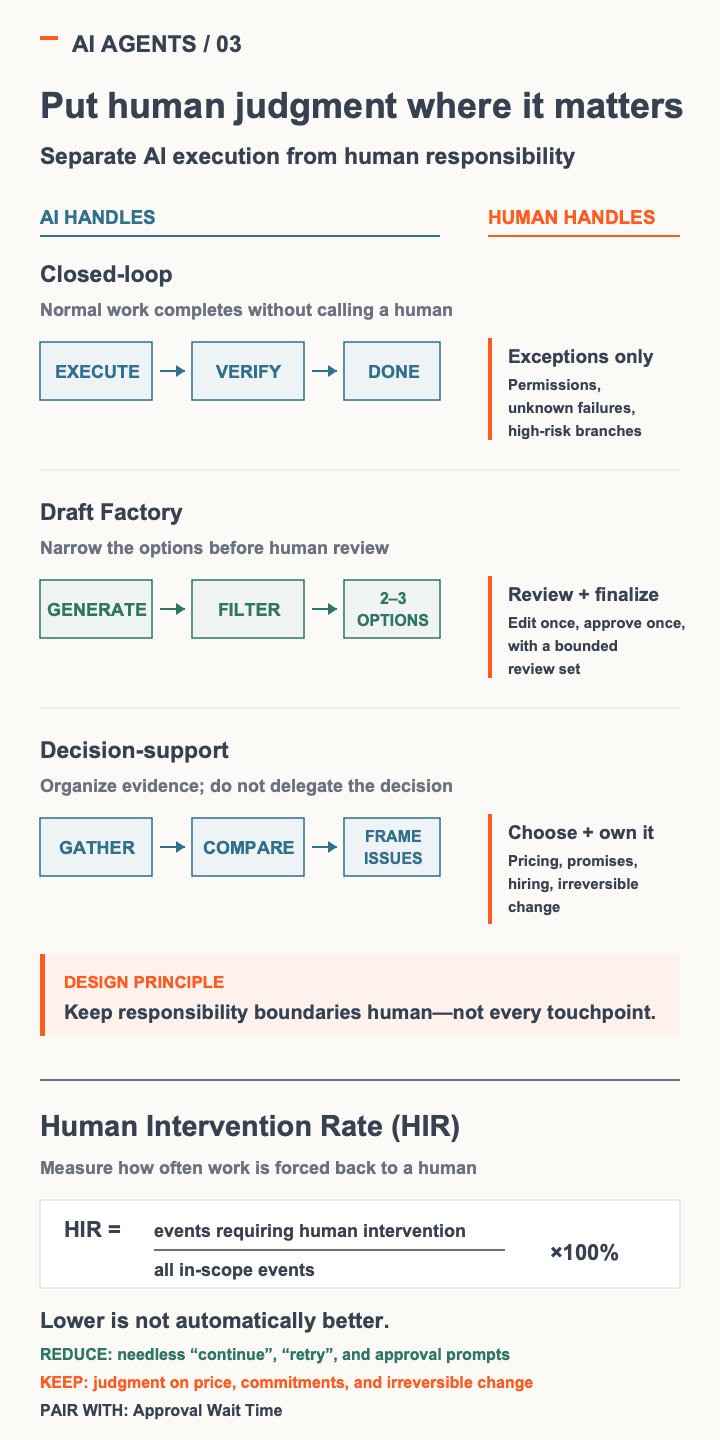
- Classify work as Closed-loop, Draft Factory, or Decision-support and decide where the human intervention point belongs.
- HIR should not be driven to zero. Keep high-value judgment and reduce low-value interruptions and approval wait time.
AI can create research, drafts, analyses, and implementation options quickly. But if every output returns to one founder or a small number of responsible people for review, faster AI simply creates a larger approval queue.
In Netsujo’s multi-agent operations, this led us to look not only at AI throughput but at how often execution had to call a human back. Human Intervention Rate (HIR) isolates that operating problem as a measurable signal.
Human Intervention Rate: measuring when AI work still depends on a human(日本語)
The goal is not to remove human judgment. It is to reduce interruptions that do not deserve human judgment and concentrate attention on decisions that do.
In a representative OECD survey of more than 5,000 SMEs across seven countries conducted in late 2024, 31% reported using generative AI; the figure for Japan was 24%. Among users, 65% self-reported improved employee performance, 35% reported helping scale the business, and 26% reported increased revenue. These are self-reported outcomes and do not prove causal effects from AI use.
OECD — Generative AI and the SME workforce
Fast AI does not make the organization fast if work waits for approval
As more implementation, research, and verification can be delegated to AI, a different bottleneck appears. If the workflow still requires a human to say “continue,” “retry,” “approve,” or “hand this to someone else,” faster AI-side processing does not translate into the same increase in completed outcomes.
This is not necessarily an AI capability problem. The bottleneck has moved from doing the work to human judgment.
The effect is especially strong in small teams. If there is one decision-maker, ten AI-generated completions still queue in front of the same person. Design first for which steps can complete without recalling a human.
Split work into three operating modes
Instead of asking whether “sales” or “development” should be automated, classify work by where human intervention is required.
1. Closed-loop: let routine work finish inside a defined boundary
In Closed-loop work, AI plans, executes, and verifies within defined conditions. The normal path should complete without returning to a human.
- Routine report generation with mechanical checks
- Data transformation under fixed conditions
- Automated tests
- Monitoring of known conditions
- Routine processing with explicit failure conditions
Humans remain responsible for exceptions, permission boundaries, and unknown failure modes. If a supposedly closed-loop workflow asks for confirmation every time, its completion or verification conditions are probably not actually closed.
2. Draft Factory: generate and narrow options before human review
In Draft Factory work, AI produces drafts or options and a human selects, edits, and finalizes the result. Articles, proposals, sales emails, and planning options often fit this pattern.
The failure mode is letting a ten-times-faster generator send ten times as many drafts to a human. That does not create throughput; it creates review inventory.
Decide how many candidates the human will actually see before deciding how many the AI should generate.
3. Decision-support: organize evidence, keep the decision human
In Decision-support work, AI gathers information, compares options, organizes issues, and presents scenarios. The final decision remains with a human.
Pricing, hiring, commitments to important customers, business shutdown decisions, and irreversible production changes often belong here.
Do not decide only on whether AI is technically capable of producing an answer. Ask whether the company must take responsibility for the decision.
Human Intervention Rate is not a zero-target metric
Human Intervention Rate = events that required human intervention ÷ all in-scope events × 100.
An intervention is a state where the workflow cannot proceed without a human judgment, instruction, or operation.
HIR = 0 should not be the target. If only two of 100 events require a human, and those two are high-value contracts or irreversible production changes, the interventions are justified.
By contrast, if 50 of 100 events require someone to press “continue,” “retry,” or “next,” the operating logic is likely the bottleneck. The useful goal is reducing Low-Value Human Intervention.
Track approval wait time alongside HIR
The same number of interventions can have very different organizational effects. Ten approvals per day may flow if the responsible person checks every 30 minutes. Two approvals can stop the entire workflow if the approver is unavailable for half a day.
| Metric | What it measures |
|---|---|
| Human Intervention Rate | Share of events that called a human back |
| Human Touch Time | Time humans actually spent interacting with the workflow |
| Approval Wait Time | Time the workflow was stopped waiting for a human decision |
| Autonomous Completion Rate | Share completed without recalling a human |
| Rework Rate | Share corrected or rerun by a human |
Measure the human attention consumed by the workflow, not only the volume of AI work produced.
Prioritize by frequency × reducible human touch time
Ranking automation candidates by frequency alone can mislead. A task that happens 100 times a day but needs only a few seconds of human touch may consume less cognitive bandwidth than a task that occurs ten times a month and requires 90 minutes of review each time.
A useful starting point is: priority input = occurrence frequency × Human Touch Time that can be reduced.
Then add failure impact, verifiability, and implementation cost. This is not a universal score; it is an entry point for ordering automation candidates.
Judgment small teams should keep human
- Set prices
- Make important commitments to customers
- Authorize large budgets
- Hire or evaluate people
- Decide whether to continue or exit a business
- Approve irreversible operations
- Change the quality standard used to evaluate the AI itself
In Netsujo’s AI operations, implementation and verification can increasingly be delegated, while positioning, publication decisions, and important production operations remain behind separate approval boundaries.
AI implementation guide: acceptance, permissions, and operating boundaries
What changed in the founder’s own time after AI adoption(日本語)
Reduce human entry points before adding more agents
- Which work can complete without human review?
- How many outputs should a human ever need to inspect?
- Which workflows can return only the final decision to a human?
- How often do people repeat “continue” or “retry”?
- How long does work sit idle waiting for an approver?
The value of AI is not removing humans from every workflow. It is returning human attention to work that actually requires responsibility, relationships, and strategy.
Frequently asked questions
- Which workflows should a small company automate first?
- Start where frequency is meaningful, human review time can be reduced substantially, correctness can be verified, and the loss from failure can be bounded.
- Is a lower Human Intervention Rate always better?
- No. Strategy, important contracts, large budgets, and irreversible actions may justify human intervention. Reduce low-value intervention instead.
- Does producing more drafts automatically increase productivity?
- Not if humans still review every draft. More generation can create review inventory. Limit the candidate set and define what can be rejected mechanically before human review.
- What decisions should stay human in a small team?
- Keep decisions where the company must take responsibility: pricing, important customer commitments, hiring, business continuation, high-irreversibility operations, and changes to the quality standard itself.
Netsujo can break down a workflow into Closed-loop execution, approval boundaries, and decision-support so that AI increases completed work instead of approval inventory.
Design where human attention should remain