
Build, Outsource, or Buy? How to Source AI Agents Without Outsourcing the Learning Loop
Tomohiro Iida · Published October 3, 2026 · Updated October 3, 2026
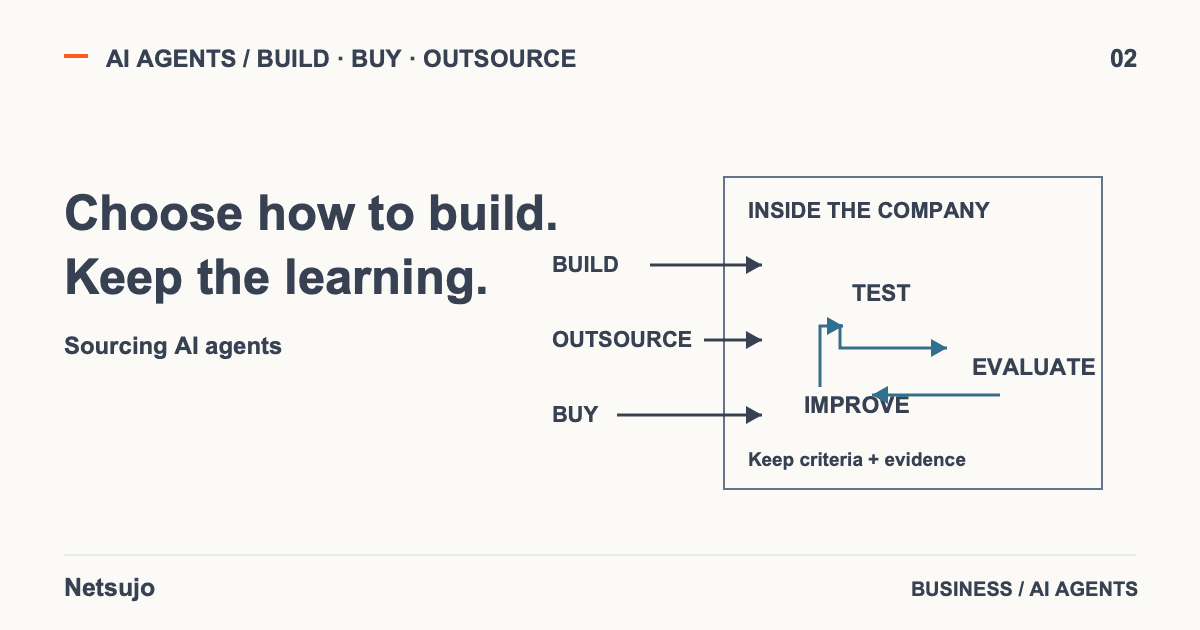
If the first AI-agent sourcing decision is only “build, outsource, or buy,” one important question gets lost: which learning loop must remain inside the company?
Key takeaways
- Build, outsource, and buy are not mutually exclusive. Different layers of one AI workflow can use different sourcing models.
- The strategic asset to retain is evaluation capability: defining what counts as good, what counts as failure, and how customer feedback changes the system.
- Compare sourcing options on change frequency, failure cost, knowledge retention, and Exit Cost—not only initial price.
In production, exceptions, customer reactions, failure patterns, evaluation criteria, and permission boundaries keep changing. The first decision should therefore be less about who writes the code and more about which learning loop the company can continue to operate itself.
Separate what you procure from what you retain
| Layer | Examples | Decision question |
|---|---|---|
| Foundation model | LLM, embeddings | Is there a reason to own the model itself? |
| Execution layer | Agent runtime, workflow | Does proprietary control create competitive advantage? |
| System integration | CRM, core systems, web | Are change frequency and permission risk high? |
| Business logic | Decision rules, exceptions, procedures | Is this company-specific knowledge? |
| Evaluation and improvement | Success criteria, failure taxonomy | Who defines what a good result is? |
A valid architecture might use external models and runtimes, outsource the initial build, and keep evaluation data and exception rules under company control.
Compare build, outsource, and buy across six dimensions
| Decision axis | Build in-house | Outsource | Off-the-shelf |
|---|---|---|---|
| Differentiation | Can fit proprietary workflows deeply | Depends on the requirements and contract | Generic features are harder to differentiate on |
| Change frequency | Fast if the company can change it directly | Depends on contract and delivery setup | Limited by product configuration |
| Failure cost | Company bears hiring, development, and maintenance cost | Can distribute initial implementation risk | Often easier to test at small scale |
| Knowledge retention | Can be retained if designed for it | Depends on handover terms | Internal product knowledge may remain with the vendor |
| Exit Cost | Can become internal technical debt | Migration and contract terms matter | Vendor lock-in is a key concern |
| Evaluation capability | Required internally | Required internally | Required internally |
The last row is non-negotiable. A company that cannot judge whether output is good or bad cannot improve the system simply by changing its sourcing model.
When off-the-shelf products should come first
For meeting summaries, general document drafting, information retrieval, and other work where using the same mechanism as competitors does not remove a strategic advantage, an off-the-shelf product is often the rational first test.
The OECD 2026 D4SME Survey reports that, in a non-representative sample of more than 2,000 SMEs across 12 countries, use of ready-made AI products was more common than deeper custom integration or AI agents. It also cites lack of time, maintenance cost, and skills as barriers.
OECD — Empowering SMEs in the age of AI: Evidence from the 2026 D4SME Survey
That sample should not be generalized to every SME. The useful point is narrower: “AI” is not a reason to custom-build a function that an existing product can already cover well.
Off-the-shelf products become less sufficient when company-specific rules are a source of advantage, workflows need deep connections to multiple systems, write permissions matter, business rules change frequently, or evaluation data should remain a proprietary asset.
Outsourcing buys build capacity—not the right to stop learning
Outsourcing fits when the company understands its business process but does not need to build AI implementation, integration, and operating infrastructure entirely by itself.
API integrations, runtimes, logs and monitoring, automated tests, and integration into business systems can all be delegated to an external implementation partner.
But the company should still be able to explain what is being automated, what counts as acceptance, which failures are unacceptable, who holds responsibility, and how customer reactions feed back into improvement.
If only the vendor understands those points, the company has outsourced its improvement capability—not just its implementation.
Build in-house where change is frequent and strategically important
The in-house decision should not be based only on initial cost. A better lens is change frequency × competitive importance.
If customer feedback changes the rules every week, or the evaluation criteria themselves determine service quality, external coordination on every change can become a constraint on business speed.
In Netsujo’s multi-agent operations, we have also moved away from binding one role permanently to a specific model or product. We separate Role from Runtime so implementation choices can change without losing the operational responsibility model.
How we separate roles across ChatGPT, Claude Code, and Codex
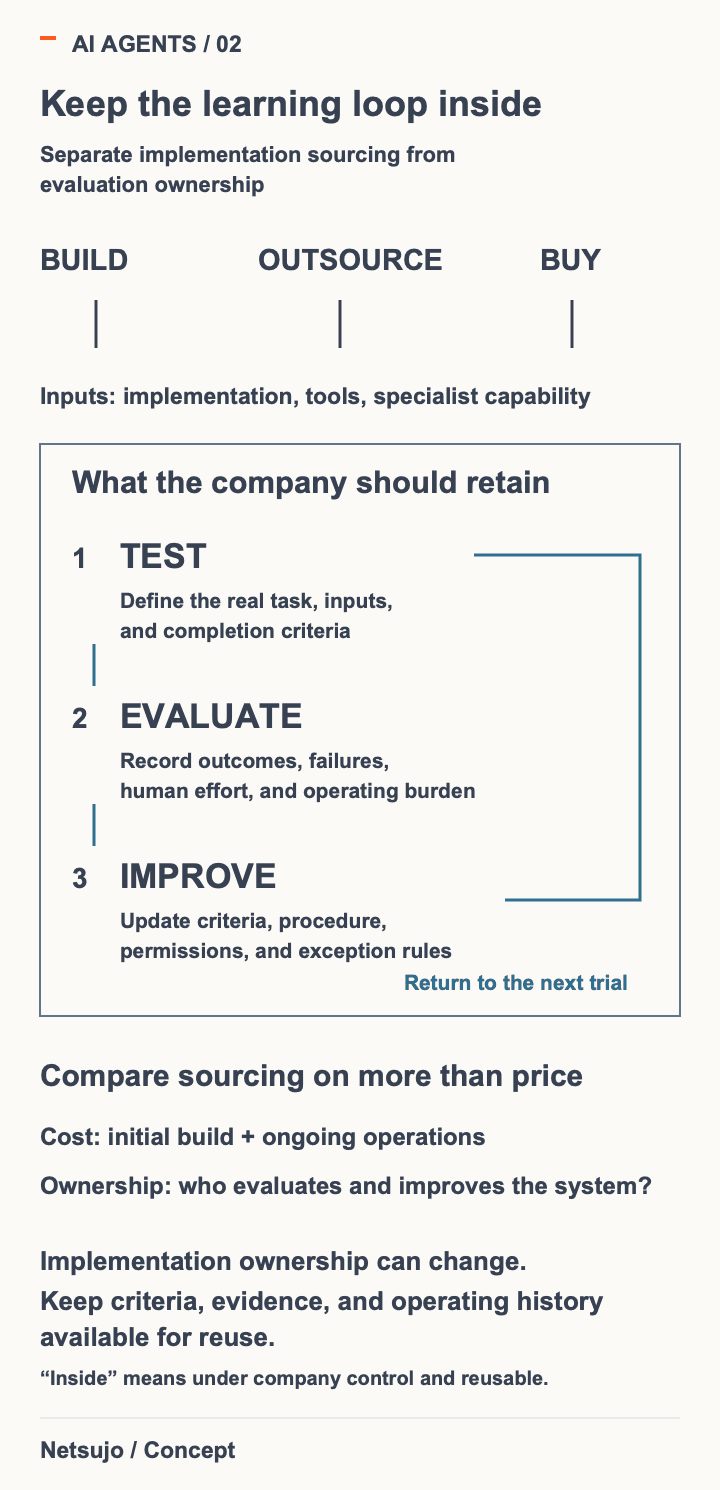
Keep the learning loop inside the company
- Test — define the real business problem, inputs, and completion criteria.
- Evaluate — record results, failures, operating burden, and human intervention.
- Improve — update decision criteria, procedures, permissions, and exception rules.
- Run the next trial — evaluate again using the same criteria.
If this loop remains available to the company, it can keep improving even when the implementation partner, model, or product changes.
Exit Cost is more than a cancellation fee
Check whether evaluation data, logs, prompts, business rules, integration specifications, and permission settings can be exported in a usable form. At contract and design time, ask whether the same evaluation conditions can be reproduced after moving to another vendor or model.
The practical answer is often hybrid
- Foundation model: external API
- Internal search: off-the-shelf service
- Proprietary workflow: outsourced initial implementation
- Evaluation data: company-controlled
- Exception rules: company-controlled
- Continuous improvement: gradually brought in-house where it matters
When uncertain, answer five questions: Does this directly affect competitive advantage? Does the specification change frequently? Is failure expensive? Does proprietary evaluation data accumulate with use? What would we need to take with us if we changed vendors tomorrow?
The asset to protect is not code ownership for its own sake. It is the ability to test, evaluate, and improve the system continuously.
Frequently asked questions
- Which option is cheapest: build, outsource, or buy?
- Off-the-shelf products often have the lowest initial cost, but total cost depends on change frequency, integration, maintenance, human evaluation effort, and migration cost. Compare total cost of ownership for the specific workflow.
- Should a company without AI engineers outsource everything?
- Implementation can be outsourced, but the business owner still needs to own the definition of correct output, unacceptable failure, final responsibility, and improvement decisions.
- Can we start with a product and later move in-house?
- Yes. Migration is easier when evaluation data, business rules, logs, and integration specifications remain accessible to the company from the beginning.
- What should be built in-house?
- The value of in-house capability rises when the workflow changes frequently, directly affects customer value or competitive advantage, and produces proprietary evaluation data as it is used.
Netsujo can break down the workflow by differentiation, change frequency, permissions, maintenance, and exit conditions before implementation.
Map the boundary between buy, outsource, and build