
How to Measure AI Agent ROI: From Time Saved to Economic Outcomes
Tomohiro Iida · Published October 3, 2026 · Updated October 3, 2026
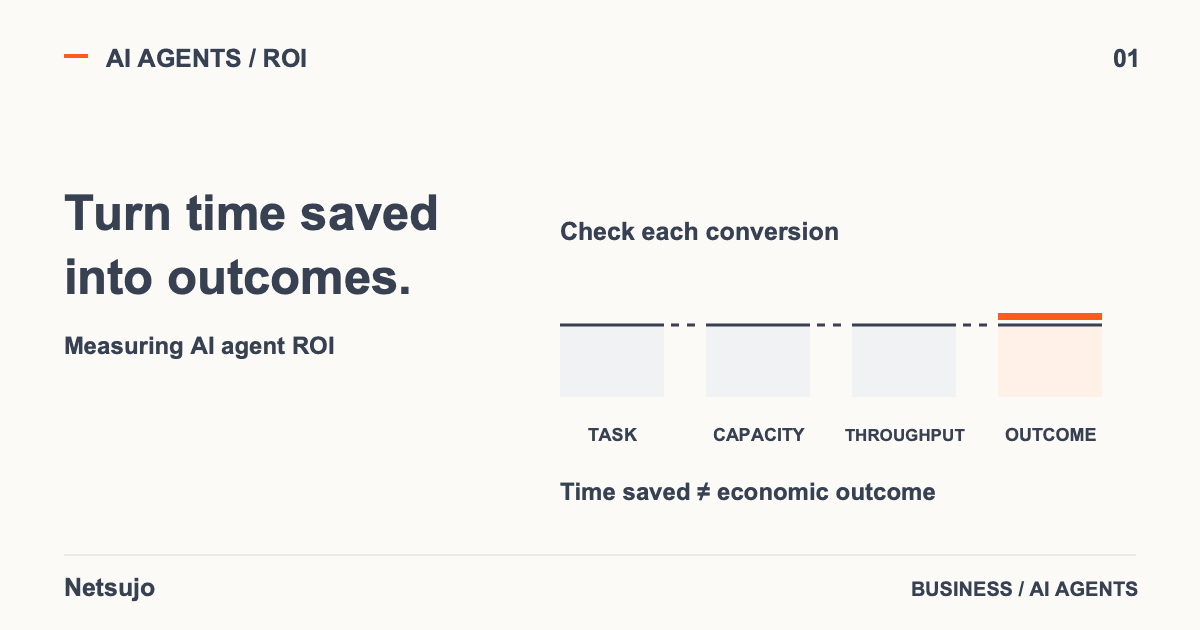
The number that needs the most care in AI agent ROI is time saved. Cutting a 100-hour workflow to 50 hours creates capacity, but that capacity does not become economic value automatically.
Key takeaways
- Time saved is not ROI. Measure task speed, human capacity, organizational throughput, and economic outcomes separately.
- Include human review, retries, exceptions, and maintenance when calculating cost per completed outcome.
- Economic Capture Rate is a practical concept used in this article to show how much potential value estimated from time savings was actually captured.
At Netsujo, AI increased the amount of work the company could process. We did not continuously measure the founder’s own AI-operation time, so we do not claim that the founder recovered a specific number of hours or that our ROI reached a specific percentage.
How AI changed company throughput—and the boundary of what we did not measure(日本語)
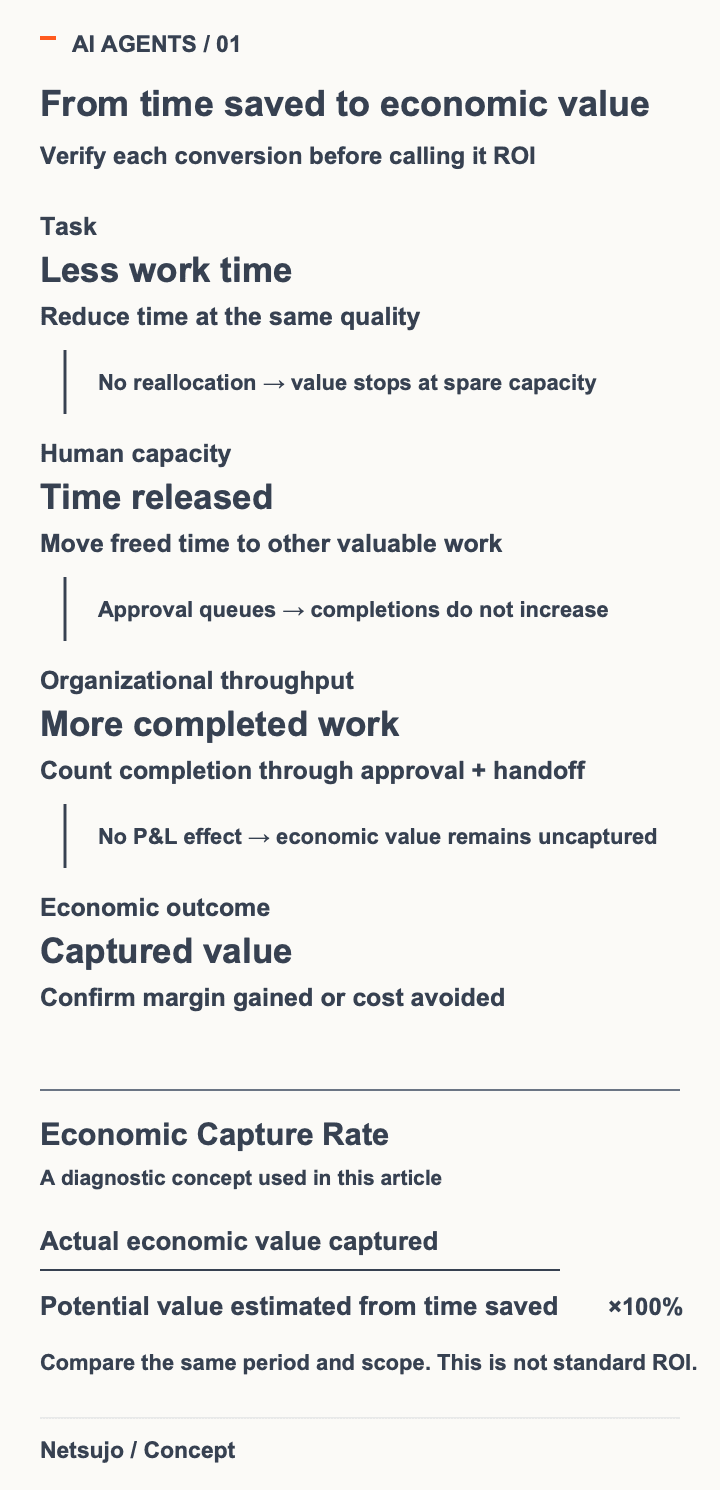
Treat ROI as a four-stage conversion
| Stage | Question to answer | Typical value leakage |
|---|---|---|
| Task | Did one unit of work become faster? | A human rewrites or rechecks most of the AI output |
| Human capacity | Did human time actually become available? | Time returns through review, retries, coordination, or recovery |
| Organizational throughput | Did the organization complete more work? | Approvals, handoffs, or cross-team queues become the bottleneck |
| Economic outcome | Did the change affect profit, avoided cost, or risk? | Capacity increased but was not redeployed to additional value |
The key is not to jump directly from a faster task to an economic outcome. Each conversion stage can fail independently.
Task: measure end-to-end completion time
“The AI finished in ten minutes” describes model-side processing time. For the business workflow, measure from request through result review, correction, retry, and approval.
A workflow where AI drafts in five minutes and a human verifies for 45 minutes can recover less human capacity than a workflow where AI takes 20 minutes and a human checks for five.
The first metric to separate is Human Touch Time: time spent instructing the AI, checking output, requesting corrections, recovering failures, and approving results. Compare that human time before and after implementation.
Human capacity: saved time needs a destination
Converting saved hours directly into labor-cost savings can overstate ROI. If salaries are fixed, freeing 50 hours does not reduce cash expense by 50 hours. The capacity has to move into additional projects, customer work, sales, lower outsourcing spend, delayed hiring, or another measurable use.
The ability to create spare capacity and the ability to convert that capacity into economic value are different capabilities.
A June 2026 ILO review of empirical research similarly distinguishes observed time savings from measurable output, income, and employment outcomes. Time saved should therefore be tracked separately from economic outcomes.
Organizational throughput: did the bottleneck just move?
After AI adoption, individual work can become faster without increasing company-wide completions. A common failure mode is simply moving the bottleneck from production to approval.
If AI finishes ten items in parallel but only one person can approve them, completed work accumulates in front of that reviewer. Track the number of items that actually reach a completed state over a fixed period, plus how often execution returns to a human.
Human Intervention Rate: measuring how often an AI workflow has to call a human back(日本語)
Economic outcome: connect throughput to the P&L
More throughput is not automatically more profit. Count value the company actually captured: incremental gross profit from additional work, outsourcing spend actually removed, hiring that could be deferred, or incident-response cost that was avoided.
If a benefit does not translate cleanly into short-term revenue, do not force a monetary estimate. Track other KPIs such as fewer quality incidents, fewer delivery delays, or more time moved into high-value work.
Economic Capture Rate: how much potential value was actually captured?
Economic Capture Rate is not a standard accounting metric. It is a practical diagnostic used in this article.
Economic Capture Rate = actual economic value captured ÷ potential value estimated from time savings × 100.
For example, assume 100 hours are saved each month and valued at JPY 4,000 per hour. Potential value is JPY 400,000. If only JPY 180,000 becomes additional gross profit or avoided cost, the capture rate is 45%.
The important number is not 45% by itself. The useful question is where the remaining 55% was lost: human review, approval queues, inability to redeploy capacity, or another constraint. Each answer points to a different improvement.
For agentic AI, measure cost per completed outcome—not cost per token
An AI agent may search, read files, call tools, retry operations, and invoke another agent for review within one business workflow. Per-token pricing alone cannot describe the economics the company actually bears.
A July 2026 McKinsey interview on agentic AI economics similarly argues for looking beyond token cost toward workflow and outcome economics.
McKinsey — Cost versus value: Managing agentic AI system performance
- AI, SaaS, and infrastructure usage
- Human instruction, review, and approval time
- Retries and corrections
- Exception handling and incident recovery
- Ongoing maintenance
Bundle those costs around one outcome and track Cost per Completed Outcome.
Seven numbers to track before and after rollout
| Metric | What it measures |
|---|---|
| Task Time | Pure processing time |
| Human Touch Time | Human instruction, review, approval, and recovery time |
| Autonomous Completion Rate | Share completed without calling a human back |
| Rework Rate | Share corrected, discarded, or rerun |
| Workflow Throughput | Completed outcomes over a fixed period |
| Cost per Completed Outcome | Total cost for one completed outcome |
| Economic Capture Rate | Share of estimated potential value that was actually captured |
You do not need perfect measurement of all seven from day one. At minimum, keep time saved, human intervention, completed outcomes, and actual economic value as separate numbers.
When ROI is low, do not blame model performance first
If the task is fast but human capacity does not increase, the review design may be the problem. If capacity increases but throughput does not, approvals or handoffs may be the problem. If throughput increases but economic outcomes do not, the constraint may be demand, pricing, or sales rather than the AI.
AI agent ROI is not mainly a verdict on whether the model is “smart.” It is a way to identify which conversion is stopping value and choose the next place to improve.
Frequently asked questions
- Can AI agent ROI be calculated from time saved alone?
- No. Separate time savings from human capacity, organizational throughput, and the economic value that is actually captured.
- What costs should be included?
- Include AI and SaaS usage plus human instruction, review, approval, retries, corrections, exceptions, monitoring, and ongoing maintenance.
- Is Economic Capture Rate a standard accounting metric?
- No. It is a practical concept used in this article to compare estimated potential value from time savings with economic value actually captured.
- What should be measured before deployment?
- Measure workflow time, human touch time, completed outcomes over a fixed period, rework, and actual costs over the same scope so the post-deployment comparison is meaningful.
Netsujo helps separate automation, human intervention, completion criteria, and business metrics before implementation.
Design AI implementation around measurable outcomes