
Event Report: We Held an Introduction to Quantum Computing Lecture
Tomohiro Iida ·
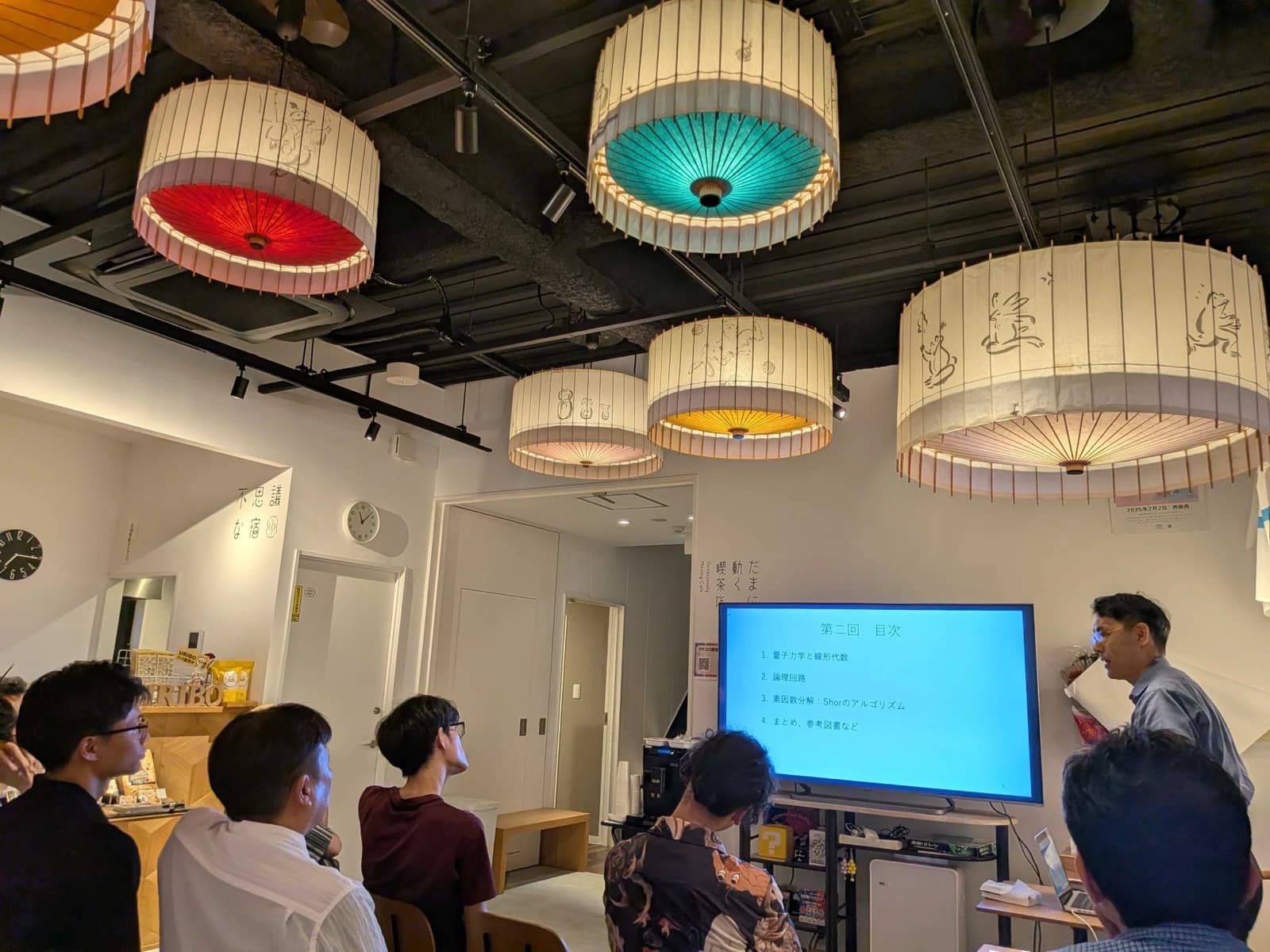
On June 29, 2026, Netsujo Inc., which runs the IT community Miyako de IT, held the second session of its ongoing lecture series "A World Beyond 0 and 1: Introduction to Quantum Computing." This session's theme was "How does quantum computation work?" The lecture covered qubits, quantum circuits, quantum gates, and Shor's algorithm — the basic mechanisms behind how a quantum computer computes. Between lecture segments, we brought in tea and beginner-friendly yoga. Building a place where participants could concentrate, think, and connect with each other, rather than simply receiving a stream of technical explanation, was one of the things we cared about most in designing this session.
Event overview
| Item | Detail |
|---|---|
| Date | June 29, 2026 (Monday) |
| Event | A World Beyond 0 and 1: Introduction to Quantum Computing |
| This session | Session 2: How does quantum computation work? |
| Quantum computing lecturer | Tetsuya Onogi |
| Affiliation | Graduate School of Science, Osaka University |
| Yoga instructor | Yuka Onogi |
| Format | Quantum computing lecture, tea, and yoga |
| Organized by | Miyako de IT / Netsujo Inc. |
connpass event page (Session 2)(日本語)
Not letting quantum computing stay a "distant technology"
What this series cares about is not leaving quantum computing as "some distant technology someone else will use one day," but building up a step-by-step picture of the whole field. Quantum computers are expected to find applications in AI, cryptography, optimization, and simulation, among other areas — but the field is also full of specialized terms like quantum mechanics, superposition, entanglement, and quantum gates, which can make it hard to know where to start.
Rather than aiming to fully understand the mathematics from day one, this series focuses on building an overall picture step by step. In Session 2, we compared classical logic circuits with quantum circuits to learn the sequence of steps a quantum computation follows.
What we covered in Session 2
- The relationship between quantum mechanics and linear algebra
- Quantum states and qubits
- The difference between classical logic circuits and quantum logic circuits
- Hadamard gates and CNOT gates
- Superposition, entanglement, and measurement
- RSA encryption and prime factorization
- Shor's algorithm
- The quantum Fourier transform
- Premises to check about quantum computers
One key point from the lecture: a quantum computer is not fast simply because it "does many calculations at once." Quantum computation builds a state that holds many possibilities, then uses entanglement and interference to raise the probability that the state corresponding to the correct answer is the one measured. Without a quantum algorithm suited to the problem, simply using a quantum computer does not make the calculation faster. We plan to keep sharing more detailed explanations of the lecture content through Miyako de IT's ongoing activities.
Why we combined lecture, tea, and yoga
We combined the lecture with yoga so that participants could reset partway through a long explanation and come back able to concentrate on the second half. Over roughly two hours, we alternated between time spent focused on the lecture and time spent on the body: tea partway through the lecture, followed by beginner-friendly yoga led by Yuka Onogi. The yoga was not strenuous — it can be done in everyday clothes, seated or standing, so it is easy to join regardless of fitness level.
A quantum computing lecture involves concepts and mathematics that rarely come up in daily life. Listening to explanation alone for a long stretch tends to reduce concentration and makes the material harder to absorb, so we built in time to move the body and reset posture and breathing, making it easier to return to focused listening in the second half. This does not mean yoga helps you understand quantum mechanics. Our view is that specialized content needs more than a large volume of information — it needs an environment designed so people can keep learning.
Designing the whole experience, not just the technical content
What Netsujo values is not stopping at introducing a technology, but designing all the way to a state where people understand it and keep using it. Netsujo works on implementation support for digital technologies including web, AI, and Web3. Introducing a technology on its own does not automatically solve a user's or an organization's problem. For a new technology to actually get used, it also needs:
- Explanations that make the underlying mechanism understandable
- Opportunities to ask an expert questions directly
- A design that is approachable even for first-time participants
- Pacing that accounts for attention span and amount of information
- Room for participants to exchange views with each other
This quantum computing session was designed around not just the lecture content but the state participants would be learning in. The same thinking applies beyond event design, to how we approach websites, business systems, and AI services: it matters not just to add features and information, but to build a state where people understand, do not get lost, and keep using what they have been given.
Learning and connection through Miyako de IT
Miyako de IT is a Kyoto-based community where people from different fields of expertise gather to learn about new technology and social issues and connect with each other. Rather than a place where one specific technology is taught one-way, it aims to be a place where participants can encounter a new topic and connect it to their own work and interests. Alongside sessions like this one on quantum computing, we plan to keep organizing events on AI, Web3, regional issues, and digital adoption, wherever technology and society intersect.
Next up: real quantum computers
Session 3 of the lecture series is planned for July 27, 2026 (Monday), on the theme "Real quantum computers." We will look at how theoretical quantum computation is realized on today's actual quantum computers, and where the technology currently stands and what challenges remain.
connpass event page (Session 3)(日本語)
Netsujo will keep creating opportunities for people and companies to treat emerging technology as more than a buzzword, and to connect it to real work and social issues.
If you are interested in co-hosting an event, study session, or pilot project on emerging technology, contact Netsujo.
Get in touch